Biorock
Technology
The process of Electrodeposition
of Minerals in Sea Water known as Mineral Accretion Technology was developed
by Architect, Marine Scientist, Prof.
Wolf H. Hilbertz, through extensive experimental applications, demonstration,
and commercial projects commenced in 1974, covering coastal defense structures, shoreline stabilization - erosion control, artificial reefs, mariculture, and marine
construction. [Reference
Publications: 1975-1981]
In the course developing
Accretion Technology directed toward structural applications, exceptional
accumulations and growth rates of marine organisms on accreting structures
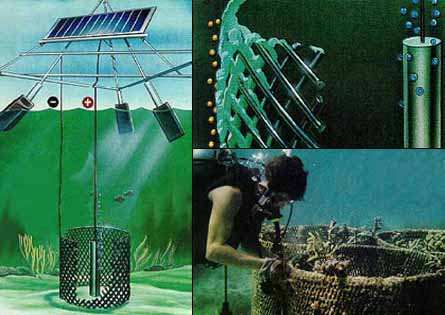
were observed. The process was further developed as Biorock "A
METHOD OF ENHANCING THE GROWTH OF AQUATIC ORGANISMS, AND STRUCTURES CREATED
THEREBY."
|
"A METHOD OF ENHANCING THE GROWTH OF AQUATIC ORGANISMS,
AND STRUCTURES CREATED THEREBY"
Biorock Coral Reef Restoration - Karang
Lestari Project
Pemuteran Bali - Videos - 2002 to 2006
http://www.youtube.com/watch?v=SXpYembcCwE
http://www.youtube.com/watch?v=_p_m7nBLHAw
http://www.youtube.com/watch?v=YOiwaLn1Pu4
http://www.youtube.com/watch?v=DBrCe5n8G6w
http://www.youtube.com/watch?v=Eyai3pMyOMI
|
In 1988, Prof. Wolf H.Hilbertz, began collaboration with Coral Ecologist, Dr.
Thomas J. Goreau, of the Global
Coral Reef Alliance, in research and development
of Biorock with a focus on coral propagation, preservation of corals, and coral
reef restoration.
Demonstration projects conducted
at number of locations around the world have involved the grafting of salvaged
coral fragments to Biorock Reef Structures.
-
Enhanced growth rates of
the salvaged corals were monitored and documented.
-
Survival of corals on Biorock
Reef Structures exceeded the survival of corals on adjacent natural coral
reef formations under severely degrading environmental conditions.
-
Biorock Reef Structures immediately
became integrated, living parts of their marine environment, providing
additional substrata available and conducive to further natural settlement
of wild corals.
-
Biorock Reef Structures ultimately hold promise to augment repopulating
of corals on natural reefs that have suffered degradation and devastation
from numerous human related and natural causes.
Electric Boost for Reefs
Video: National Geographic News
http://news.nationalgeographic.com
Dr. T.J. Goreau, Global Coral Reef Alliance
at United Nations Climate Change Conference
Bali, Indonesia - December 2007
Electricity Revives Bali Coral Reefs
Pemuteran Bay, Indonesia, December 4, 2007
http://news.nationalgeographic.com
National Geographic News - Associated Press Article
|
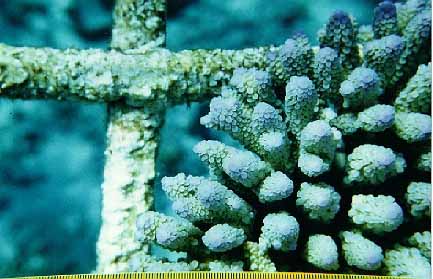
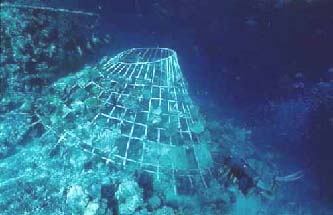
"Maldive Barnacle" Biorock Reef Structure, constructed in 1996.
Photo. 1997
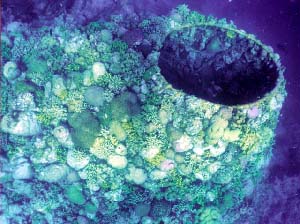
"Maldive Barnacle" Biorock
Reef Structure
April 1999
Restoration of coral growth under "impossible" conditions.
In the Maldives in 1998 only 1-5% of corals survived heatstroke caused
by global warming, but in the same habitats, 50-80% of the corals on Biorock
structures survived.
|
Business and Professional inquiries regarding Biorock can be directed to:

|
Biorock is the Trademark of Biorock Inc.
Biorock is a Patented Process Owned by Biorock Inc.,
Protected
under International Intellectual Property Legislation.
Copyright © Applies to All www.Biorock.Net
Website Content.
All rights reserved.
|
|
The following publications are available at:
http://www.ieee.org [Note: IEEE Search "Hilbertz" ]
http://ieeexplore.ieee.org/search/freesearchresult.jsp?history=yes&queryText=%28hilbertz%29
1.
Electrodeposition of minerals in sea water: Experiments and applications
Hilbertz, W.
Oceanic Engineering, IEEE Journal of
Volume 4, Issue 3, Jul 1979
2.
Electrodeposition of Minerals in Seawater
Hilbertz, W.
OCEANS
Volume 10, Sep 1978
3.
Restoring coral reefs, oyster banks, and fisheries by seawater electrolysis: coastal zone management and tourism applications
Goreau, T.J.; Hilbertz, W.; Azeez, A.; Hakeem, A.; Dodge, R.; Despaigne, G.; Shwaiko, C.;
OCEANS 2003. Proceedings
Volume 2, 22-26 Sept. 2003
4.
Shore protection, beach formation, and production of building materials and energy using seawater electrolysis technology
Goreau, T.J.; Hilbertz, W.; Azeez, A.; Hakeem, A.; Allen, J.;
OCEANS 2003. Proceedings
Volume 5, 22-26 Sept. 2003
|